
 When President Obama announced last spring that he wanted to trim $400 billion from national security programs in an effort to address the country’s fiscal crisis, the question was whether this was a ceiling to further cuts or just its floor.
Coming on the heels of $400 billion already cut from the defense budget the last two years by the administration, the hope was that it was a ceiling.
But Tuesday, the “Gang of Six” –a bipartisan group of U.S. Senators–put forward a proposal to trim $3.7 trillion from the government’s budget over the next ten years. President Obama’s praised the plan and declared it “broadly consistent” with his approach for getting the country’s finances under control.
Although the plan is somewhat sketchy on how these savings will be achieved, it is noteworthy that Sen. Tom Coburn (R-Okla.), a key member of the six, recently put forward his own plan that included $1 trillion in defense cuts over the next decade.
Reading the tea leaves, it seems pretty obvious that defense will be the largest bill-payer for addressing the deficit.
Understandably, the country wants its elected representatives to address the nation’s fiscal crisis. But in doing so, will it be creating a crisis on the national security front?
Indeed, what is striking about the various deficit-reduction proposals is how often they are proposed in abstraction from the known threats and requirements that the country faces today and will likely face in the future. Whatever one thinks about the advisability of cutting this or that military program, reducing benefits for the all-volunteer force, or trimming numbers in active duty forces, at a minimum, such decisions should be tied to some strategic calculus about what role we want the United States to play in the world today and tomorrow. Maybe our allies in Europe can get away with just making defense cuts a budget exercise but it is extremely dangerous for Washington to go down this road.
Whether we like it or not, in the next few years, we will still be dealing with the conflict in Afghanistan, an aggressive and likely nuclear-capable Iran, the continuing threat of Islamist terrorism, possibly a failed, nuclear-armed state in Pakistan, a Putin-led and revanchist Russia, a rising and increasingly assertive China, and of course the seeming never-ending problem child of Asia, North Korea.
Add to that the requirement to protect the American homeland and maintain assured access to the global commons–sea, space and cyberspace–and one quickly sees why the U.S. defense budget is as large as it is. There is a lot on the country’s plate.
And this is what we know is on our plate. But if the past quarter century has taught us anything, it’s that strategic surprises are just as likely to occur as not–and that includes wars that no one expected to be fighting. When George H. W. Bush was elected president in 1988, Panamanian dictator Manuel Noriega was clearly a problem. Nevertheless, Bush was not expecting that just a little more than a year later, he would be ordering an invasion of Panama. Of course, the bigger surprise was the First Gulf War. Even when Saddam Hussein had massed troops on Kuwait’s border, only a few individuals saw this as a prelude to an actual invasion, let alone the opening act in what would end with an American-led counter-invasion in 1991 totaling well over a half-million men in arms.
Similarly, when President Clinton began his presidency in 1993, he was undoubtedly aware of the fact that Yugoslavia was flying apart, with Slovenia, Croatia and Macedonia already having declared their independence from Belgrade. But equally certain is the fact that he had no idea that just a few years later he would be ordering U.S. aircraft to bomb Bosnian Serb positions in 1995 to stem the Serb militia’s onslaught against the Muslim Bosniaks and UN-designated ” safe areas.” And even less improbable for candidate Clinton was President Clinton’s decision, in conjunction with NATO allies, to engage in a sustained bombing campaign in the spring of 1999 against Yugoslavian forces, government installations and key infrastructure in a successful effort to force Milosevic’s military to leave Kosovo and prevent a repetition of the bloody violence and massacres that had occurred previously in Bosnia.
For his part, George W. Bush came to the White House determined to avoid such conflicts. Indeed, an argument among many of his senior advisors was that the United States had entered an era of ” strategic pause” in which the United States could focus on domestic affairs and the transformation of its military in the absence of a great power rival. However, as we know, by the end of his first term, President Bush and the Congress had authorized wars that resulted in tens of thousands of troops being deployed in both Afghanistan and Iraq.
Nor has President Obama escaped his own unexpected war. Even while determined to end combat operations in Iraq and drawdown in Afghanistan as quickly as possible, Obama now finds himself in armed conflict with Libya. Although it is clear that this was not something he wanted to do, nevertheless, the U.S. navy and air force, in conjunction with NATO allies, are slowly but surely engaged in attempting to squeeze Qaddafi out of power.
Four presidents and various wars later, it is obvious that whatever the policy predilection or party affiliation of the person sitting in the Oval Office they likely will be faced with, as former Defense Secretary Donald Rumsfeld noted, the problem of going ” to war with the army you have…not the army you might want or wish to have at a later time.”
Those arguing for deep cuts in the defense budget will suggest that the majority of these conflicts were avoidable. Yet, in doing so, they are ignoring the realities of history, statecraft and domestic politics. And cutting troops or buying fewer planes or ships is not going to change those dynamics. However, what it will do is leave the men and women of the American military in a far more precarious position to carry out what we as a nation will almost surely be asking them to do.
Cross-posted from Fox News.com
(U.S. Navy/Mass Communication Specialist Seaman Michael Feddersen)

Defending Defense: Warning! Hollow Force Ahead
 National security is neither a “sacred cow” nor just another federal budget line item. Providing for the common defense of the American people and our homeland is the primary responsibility of policymakers in Washington. However, in an effort to protect social entitlements like Medicare, Medicaid, Social Security and the health care reform law from serious deficit and debt reduction efforts, President Obama has proposed not only to raise taxes, but also to cut another $400 billion more from future national security spending. As Obama said on June 29, 2011, “[Outgoing Secretary of Defense] Bob Gates has already done a good job identifying $400 billion in cuts, but we’re going to do more.”
It appears the President wants to do much more when it comes to cutting defense. This week, Obama praised the latest in a series of plans to cut military spending by roughly $900 billion or more. He said the most recent plan that proposes cutting $886 billion from defense is “broadly consistent” with his own approach for getting the country’s finances under control. Although this plan, like the others, is light on details of how it would actually achieve trillions in overall spending cuts, it is clear that there is a willingness within the administration and among some members of Congress to slash defense well beyond the President’s earlier mark of $400 billion.
So far, the debate over long-term defense spending cuts has been a war among accountants–an abstract numbers game played with little regard for its concrete effect on the future of America’s armed forces and national security. This backgrounder describes the likely results of the significant defense spending reductions now being considered: a “hollow force” characterized by fewer personnel and weapon systems, slowed military modernization, reduced readiness for operations, and continued stress on the all-volunteer force. If realized, this modern day “hollow force” will be less capable of securing America’s interests and preserving the international leadership role that rests upon military preeminence.
Myth: Proposed cuts represent a small part of future military spending.
Fact: When adjusted for inflation, President Obama’s April 2011 proposal to cut $400 billion in long-term national security spending accounts for anywhere between 5%-to-8% of projected defense spending over a 12-year-period. For many, this appears to be only a marginal reduction in the Pentagon’s budget.
However, the President’s $400 billion in cuts is best understood as a floor–rather than as a ceiling–for reductions to baseline defense spending. If news reports are accurate, senior Obama administration officials and key members of Congress appear open to cutting the military’s future budget even more deeply. More likely, the cuts will occur over ten fiscal years starting in February 2012 when the President’s 2013 defense budget request arrives on Capitol Hill.
Moreover, it is worth recalling that Obama has already presided over two rounds of reductions to defense spending. In 2009, $330 billion was cut from future procurement programs and, in 2010, another $78 billion was sliced from the Pentagon‟s budget. Add these to Obama‟s new $400 billion in proposed cuts, and overall reductions to defense spending will surpass $800 billion–with perhaps even more cuts to come. Combined with the “procurement holiday” of the Clinton years and the “hollow growth” of the Bush years, when it comes to military modernization the Pentagon already finds itself in a deep hole. New cuts will create an even deeper hole.
Other factors will exacerbate the effect of Obama’s $400 billion in defense cuts. First, estimated long-term defense “savings” are premised, in part, on the Obama administration’s assumptions about a total withdrawal from Iraq, a greatly reduced role in Afghanistan by 2014, and the absence of unforeseen crises and contingencies in the future. Second, estimates of future defense spending requirements assume annual inflation will grow at just 2 percent, a rate that is wildly optimistic and in contradiction to the long-term tendency of defense inflation to outpace civilian inflation. Third, without significant reform, costs for military health care–which already represent 9 percent of Pentagon spending–are on course to double by 2030. And fourth, even before the administration began making cuts to national security spending, the Congressional Budget Office (CBO) had already predicted that the Pentagon’s research and procurement accounts would fall to just 28 percent of total defense spending.
Myth: Iraq and Afghanistan withdrawals will alleviate the military’s manpower problems and allow the armed forces to control personnel spending.
Fact: As recent U.S. military commitments outside of Afghanistan and Iraq have shown, the pace of operations is likely to remain high. President Obama has maintained every foreign policy commitment set by his predecessors and added to the military‟s missions. The President surged forces twice in Afghanistan, started a new operation in Libya, sent troops to Japan and Haiti for disaster relief operations, and kept 1,200 National Guard troops at America’s southwest border.
The demand for military personnel may not decline.
The future posture and operational tempo of U.S. forces abroad are far from certain. In Iraq, current administration policy and defense planning are premised on a complete withdrawal by the end of 2011. That could quickly change, however. The government in Baghdad has indicated openness to a continuing American military presence after 2011. Indeed, Secretary of Defense Leon Panetta recently urged the Iraqis to consider allowing at least 10,000 U.S. troops to remain.
In Afghanistan, Secretary Panetta has noted that, even after the “surge” drawdown scheduled to run through 2012, 70,000 U.S. troops will remain. While Afghan security forces are scheduled to “take the lead” in security missions after 2014, it is likely that a significant U.S. military presence in the country will still be required. To be sure, it would not be responsible to base future U.S. planning in Afghanistan on the assumption of continued large-scale NATO assistance. At minimum, the United States should be prepared to retain brigade-sized forces in Kabul and in all the current NATO regional commands, including a larger presence in the Pashtun south and east, while continuing efforts to build Afghan military capability. For such objectives, an estimate of 40,000 troops in Afghanistan past 2014 is conservative.
Forces in Iraq and Afghanistan would represent only a part of U.S. posture in the greater Middle East–a historically unstable region now in the throes of a further transition and facing the prospect of an accelerated regional nuclear arms race sparked by Iran. Both the Bush and Obama administrations have attempted to reposture and redeploy U.S. forces to the Pacific, though the efforts have been slowed due to wartime needs, limited construction funds, and political uncertainties.
Importantly, recent history tells us to expect the unexpected. The last four U.S. presidents–two Republicans, two Democrats–have each sent America’s military into harm’s way for wars that were not anticipated.
Even if the U.S. military quickly clarifies its operational picture, it still will face, in addition to the rapid rise in health and benefits costs, expected increases in military pay. According to a Congressional Budget Office analysis, costs for base military pay will likely rise by $5 billion more than planned in the next five years. “Two of the big places the money is, is in pay and benefits,” lamented Adm. Mike Mullen, chairman of the Joint Chiefs of Staff.
In sum, the size and disposition of today’s forces do not account for likely realities and unforeseen contingencies, and the military’s personnel accounts will continue to consume an increasing share of the Pentagon budget. Cuts to the military’s top-line budget will exacerbate all these troubles.
Myth: U.S. armed forces will continue to enjoy a technological advantage over any and all adversaries.
Fact: The Pentagon has nearly skipped a generation of modernization programs while, at the same time, failing to “transform” U.S. forces for the future. The defense budget growth of the past decade was largely on consumables related to current operations. All of the defense cuts over the past two years mortgaged the future to pay for the present.
Today America’s military flies the same basic planes (e.g., F-15, F-16 and F/A-18 fighters; B-52, B-1 and B-2 bombers and a variety of support aircraft), sails the same basic ships (e.g., Trident ballistic missile and Los Angeles-class attack submarines, Aegis-equipped destroyers and cruisers, Nimitz-class aircraft carriers), and employs the same basic ground systems (e.g., Abrams tanks, Bradley fighting vehicles, Black Hawk and Apache helicopters) that it did at the end of the Cold War. The White House and Congress prematurely terminated, or never brought to production, follow-on systems such as the F-22 fighter, the Seawolf-class sub, or the Comanche helicopter. As a result, tens of billions have been invested on development with little fielded reward.
The F-35 fighter remains the sole major pillar of post-Cold War procurement–yet even that has been whittled away and now stands in danger. In his final day at the Pentagon, Secretary Gates said that purchases of F-35 fighters “might be cut back as part of the Pentagon’s new budget review.” Indeed, he had already placed the Marine Corps’ variant of the F-35 on a two-year “probation.” At the same time, while the Air Force has reduced its total F-35 procurement plans to about 1,700 aircraft, it has also identified a fighter shortfall of about 800 aircraft. The Air Force thus finds itself forced to extend the life of its existing F-15 and F-16 fleets. The Navy is in the same boat, and is extending its buy of F-18s fighters. Even these efforts to maintain an aging legacy fleet and buy additional fourth-generation tactical fighters are at risk due to budget cuts already underway.
No doubt, supposedly transformational systems like remotely-piloted vehicles have made immense contributions to the irregular warfare efforts in Iraq and Afghanistan. That said, the original vision of a new regime of high-technology conventional systems to offset Chinese military modernization has yet to be realized. The so-called “Next Generation Bomber,” the symbol of the defense transformation program, was originally planned for 2018 production, but then that date slipped with the 2010 budget cuts. Indeed, the project was directed to “close up shop” and has been subsumed in a broader long-range strike effort and a new program office created within the Air Force.
This dilemma–shortfalls of modernization and failures of transformation–plagues all of the military services. The looming budget cuts will diminish the number of current procurements like the F-35 fighter, while also delaying the day when more revolutionary capabilities will be developed and fielded.
Myth: Even if the future force is smaller, it will be well prepared for future crises and contingencies.
Fact: The U.S. military is on an almost-inevitable–and unsustainable–path toward a 21st-century form of “hollowness” that will leave it less prepared for unforeseen crises and contingencies in the future.
The long-term geopolitical trends reflect protracted and persistent irregular wars in the Middle East, nuclear proliferation in unstable regions, and a rising China that continues to modernize its military with the aim of undermining American dominance in the Asia-Pacific theater. In contrast, the military has struggled to recapitalize our own forces, has fought two major wars with only incremental increases in manpower, is beset with rising personnel costs, and faces the prospect of rising operational and maintenance costs as it operates aging and worn-out systems.
The Defense Department and Congress have worked hard to ensure that troops sent into harm’s way are well prepared and equipped; however, the military’s superb performance on the battlefield masks the true state of overall readiness. There is not a service–Reserves and National Guard included–which has not reported serious readiness shortfalls in the past few years. As an example, over half the Navy’s deployed aircraft is not ready for combat. It is also important to consider the state of non-deployed U.S. forces, the country’s strategic reserve. Here the contrasts are increasingly stark. For example, the recent congressional testimony of Marine Lt. Gen. Frank Panter provides insight into the large-scale problem that all services face: “We continue to globally source equipment for Afghanistan and to meet other equipment requirements as we rapidly respond to emerging threats in the Middle East and elsewhere around the globe.”
In other words, the Marines are stripping equipment from units across the world to sustain those in the fight. Panter added: “The supply rating of units at home station hovers around 65 percent.” The Marines also discovered that their basic tables of organization and equipment were too small–that is, they didn’t have enough equipment to begin with before a decade of combat operations had ensued.
The result, combined with the fact that those in ground combat units are the most frequently deployed Marines and soldiers, is “a reduced ability of equipment to outfit and train our non-deployed units.” As the Corps scrapes the global barrel to outfit units now fighting, those units recovering or preparing for deployment are unable to conduct sustainment training and must accept a risky, just-enough approach to high-end training immediately before going to war. The long-term effect of just-in-time readiness is therefore a growing bill just for “reset”–that is, the cost of restoring the Marines’ gear to its pre-war condition that puts aside the costs of it for the future. Indeed, the Marines now estimate their reset costs at $10.6 billion, of which about $5 billion remains unfunded.
While no comprehensive analysis for long-term readiness has been undertaken, the rough overall pattern is apparent: the future of American national security is being mortgaged to fight today’s wars and reduce the deficit by an insignificant amount. As a result, America’s armed forces, which have been stretched thin for nearly a decade, will likely be asked in the years ahead to do the same or more with even less if defense spending is cut once again.
Defending Defense is a joint project of AEI, the Heritage Foundation and the Foreign Policy Initiative.
For the PDF version, click here.
(flickr/US Marine Corps/Sgt. Brian A. Lautenslager)
Present in Asia? With What?
 “I know the U.S. is still recovering from the financial crisis.…Under such circumstances, it is still spending a lot of money on its military. Isn’t that placing too much pressure on the taxpayers? If the U.S. could reduce its military spending a little and spend more on improving the livelihood of the American people and doing more good things for the world — wouldn’t that be a better scenario?”
This was the Chinese People’s Liberation Army Chief of General Staff Gen. Chen Bingde’s suggestion to Americans during the visit of his counterpart Chairman of the Joint Chiefs of Staff, Admiral Mullen. Well, we are obliging the Chinese general — at least in part. We are cutting defense. General Chen would be especially happy to know that in particular we are foregoing investment in the types of systems that help keep us “present” in Asia — though Admiral Mullen assured Asian audiences that we will be there for the long haul. Whether we are cutting defense in order to improve the livelihood of the American people is a separate, hotly debated question. Color me skeptical.
But on the first part of General Chen’s suggestion, here is how we are heeding his advice. We are not properly resourcing: a) the submarines the Navy says it needs, or, for that matter, the number of ships in its own shipbuilding plan; b) stealthy tactical aircraft (by the Air Force’s own account, they will face an 800-fighter shortfall later this decade); and c) a long-range bomber, now called “the long-range strike family of systems,” particularly by those who think this system is silver bullet for our Asia posture. We were supposed to be deploying new bombers by 2018. Not a chance. The program is estimated to cost $40-50 billion in total, and respected aerospace analyst Richard Aboulafia predicts that we will not see a new bomber until well into the next decade. Yes, that’s right, a new bomber somewhere in the 2020s.
So General Chen, no need to worry about our defense spending — we will not have enough submarines or tactical aircraft, and there is no new bomber on the horizon. All are supposed to play a role in the much vaunted AirSea Battle strategy that is our answer to China’s growing military power.
But Mullen insists, as did Secretary Gates and other top U.S. leaders, we will still be there for our friends and our allies. Given the numbers, the next time a leading U.S. official insists that we are going to be “present” in Asia, journalists have a duty to ask, “With what?”
Cross-posted from ForeignPolicy.com.
(DoD photo)
An Extremely Immodest Proposal
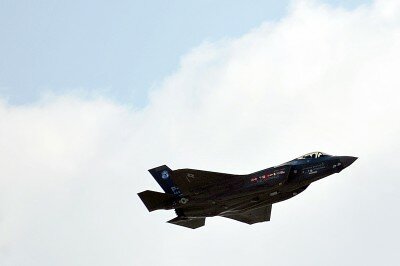 In a letter to new Defense Secretary Leon Panetta last week, Senators Carl Levin and John McCain, the top men on the Senate Armed Services Committee, suggested it was time to look into terminating the F-35 Joint Strike Fighter program. Angered by cost increases for the first three lots of low-rate production on the Lightning, the two senators asked Panetta to tell them “what would be our legal obligations and our costs if we were to terminate the F-35 program now.”
No doubt the legal and monetary obligations would be great, but the strategic, operational, and defense industrial consequences of terminating the F-35 program would be catastrophic. To begin with, the F-35 is a multinational program. To kill it would not only yank the rug out from under America’s closest friends and allies – long-time partners like Great Britain, Australia, and Canada, for example – but destroy the prospects for closer partnerships in the Middle East and, particularly, the Asia-Pacific, where Japan, Korea and Singapore are likely F-35 customers. And it would forestall the opportunity to share a common fifth-generation aircraft with others like India, which could only turn to Russia or try to develop such an aircraft on its own. Terminating the F-35 would be the clearest signal one can imagine, even beyond retreat from Iraq or Afghanistan, that the United States no longer will assume the burdens of international security.
Terminating the F-35, or simply terminating the F-35B short take off vertical landing (or STOVL), would be fatal for the Marine Corps as a serious war fighting service. The modernization of the Marines is already at risk; the V-22 Osprey tilt-rotor transport turned out to be more difficult and more expensive than anticipated, and last year the Obama administration cancelled the Expeditionary Fighting Vehicle, which would have given the Marines both enhanced amphibious assault capability but, even more important, more firepower and mobility ashore. The Marines’ AV-8B Harriers – a development of the original British jump jet – are at the end of their service life, and the Marines’ F-18s cannot operate from Marine amphibious assault ships. And there’s hardly reason to have the big-deck amphibs without the F-35B. Conversely, operating a fifth-generation aircraft would give the Marine Corps a new viability in small-scale contingencies – think Libya – and allow them to contribute to more challenging “anti-access, area-denial” contingencies in East Asia or in an Iran-type operation. Similar challenges face the Navy; without a fifth-generation aircraft, its own aircraft carriers are increasingly irrelevant to high-end strike campaigns.
Ending the F-35 program would also eviscerate what remains of the American military aviation industry. Only two companies in the world have prime contractor experience in building manned “stealth” aircraft, Northrop Grumman and Lockheed Martin. Northrop’s B-2 bomber, designed in the late 1970s, was last bought in 1997; only 21 of a planned 132 bombers. Northrop is no longer in that business. Lockheed built the F-117 Nighthawk, the first stealth fighter, another 1970s design and also long out of production. Lockheed also builds the F-22 Raptor, but that program was ended (with just 187 of a planned 750 aircraft produced) two years ago and the last F-22 will soon roll off the line. The F-35 line itself was sized (and the workforce planned) to build up to several hundred planes a year; under current plans, it’s not going to reach maximum efficiency. Indeed, the company may have to lay off workers. There’s no other place for the designers, engineers, or management to go; the investment, knowledge, and production experience to make stealthy, manned combat aircraft will rapidly disappear.
Of course, the two senators know all this; the letter is meant to pressure and publicly punish the Pentagon and Lockheed. But in this season of deficit, debt, and budget wrangling, politicians’ posturing can have consequences. Former Defense Secretary Robert Gates already had placed the STOVL variant of the F-35 on two-year “probation.” Gates also recently suggested – it was no surprise, really – that the new round of defense budget cuts introduced by the Obama administration (which have now risen from $400 to $500 billion in future spending, and are still rising) would result in fewer F-35s being bought. And with few other procurement programs left – across any of the military services – the F-35 is a big, juicy target for people wearing green eyeshades.
I thought that way once, more than ten years ago. As the principal scribe for the defense report of the Project for the New American Century, I argued that it would be preferable to buy more F-22s than to proceed with the massive F-35 program, which put so many eggs in a single basket with so many engineering problems still to be sorted out. But McCain and Levin are suggesting that we now do to the F-35 what was done to the F-22: terminate the effort with development and a tiny amount of procurement.
That’s no longer a responsible choice or a realistic position. I’ve only outlined the consequences of terminating the F-35 and closer analysis would only reveal more problems. Loren Thompson of the Lexington Institute described the McCain-Levin letter as part of a “bad week for U.S. airpower.” But it was more than that. The letter calls into question the future of American military power in its broadest sense.
Cross-posted from the Weekly Standard.
(DOD/Cherie Cullen )
Can Britannia Rule the Waves without Carrier Strike?
 A report released last week by Britain’s National Audit Office (NAO) calls into question the future of the Royal Navy’s aircraft carrier program. This report follows last year’s Strategic Defence and Security Review (SDSR), an overhaul of the British armed forces resulting from the new Tory government’s decision that significant cuts to the British defense budget were necessary in light of the U.K. fiscal crisis. Among the more notable decisions was to mothball the Royal Navy’s carrier fleet along with the associated air wing. The SDSR did, however, recommend continued procurement of two new carriers, arguing that the costs associated with stopping construction were sufficiently steep that it made more sense to go ahead with the program—although the review also indicated that it was highly likely that only one of the two carriers would be put into active service and certainly not before 2020. But the NAO report puts into question whether even this is likely unless “there is a real terms increase in defence funding in the latter half of the decade.”
Complicating matters is that the eventual bill for maintaining a carrier strike capability is still uncertain. According to the NAO, the precise costs are still undetermined, and will not be fully assessed until late 2012. This is not all that surprising given the scale of the program, and the decision to install catapults on the carrier deck and equip the carrier with F-35Cs rather than the Royal Navy’s traditional “jump jets,” but it does suggest that, unless there is a marked increase in defense spending starting in 2015, the British government will face another significant round of cuts to its defense capabilities.
Upgrades aside, the fact is that the Royal Navy is out of the carrier business until the next decade. And, even then, only 150-200 days of available carrier strike are expected per annum. However dismal this prospect may be, arguably, it would be worse still from a British perspective to lose a carrier strike capability altogether. The new Queen Elizabeth-class would extend Britain’s global reach, afford interoperability with American and French navies and amount to a major qualitative upgrade from the now mothballed Invincible-class. But whether the UK can afford even this capability is a serious question that the NAO report has, with a loud plop, put on the table.
(flickr/Ministry of Defence Kelly of McAlinden)
Karzai’s Slain Brother Leaves Perilous Power Vacuum
 Afghan President Hamid Karzai’s half-brother, the most powerful and controversial figure in southern Afghanistan, was assassinated by a senior associate this morning at his home in Kandahar City. The death of Ahmed Wali Karzai leaves a perilous power vacuum in the south at a critical time when the United States and NATO are trying to consolidate security gains of the past year, repel the Taliban’s summer offensive, transition security to the Afghan lead, and shift the fight against the Taliban from the south to eastern Afghanistan.
For the U.S. military, Wali Karzai was both an asset and a liability. He was the de facto governor of Kandahar, and his dominance over Kandahar’s security, political, and economic affairs was seen as a major setback to improving local governance and establishing an accountable and democratic leadership in the region. He had his own private militias and was accused of being the ringleader of regional drugs and criminal mafia.
Despite these flaws, however, he proved to be a staunch ally of the United States and NATO in the fight against the Taliban and al Qaeda. Both the CIA and the military relied on his influential network to maintain stability in the strategically important province. Unlike President Karzai, he wanted U.S. troops to stay in Kandahar, and, on several occasions, mobilized the tribes to support anti-Taliban offensives by the coalition forces.
His death also means that President Karzai will now find it hard to have the same level of influence and control in Kandahar, as he had completely subordinated security and political affairs in the province to his half-brother. This will be a big challenge for the embattled president, who is in an intense conflict with the parliament that threatens to impeach him and is readying his government for the transition process.
Wali Karzai’s death is the latest in a series of assassinations of senior Afghan officials over the past months, such as Kandahar’s police chief, the top police commander of northern Afghanistan, and the governor of Takhar province. The Taliban claimed responsibility for Karzai’s assassination immediately, but the killing appears to be more as a result of personal or family feud than a Taliban plot. Mohammad Sardar, the assassin, was from Wali Karzai’s village and his trusted confidante for almost a decade.
Regardless of who was behind the plot, Wali Karzai’s assassination is a big propaganda and morale victory for the Taliban. The insurgents are now likely to step up targeted killings and suicide attacks in the south to shaken public confidence in the ability of the Afghan government and foreign troops to stabilize the country.
Kandahar is the strategic birthplace of both the Taliban and President Karzai. It is also the focus of the U.S. military surge that drove out the Taliban from their strongholds in and out of Kandahar City. Ahmed Wali’s killing threatens to undo the security gains, as it will change the power structure in Kandahar and trigger a power struggle between members of Karzai’s family and leaders from competing influential tribes—which the Taliban will try to exploit. It remains to be seen what steps President Karzai will take to hold control over and maintain stability in the province.
Cross-posted from the Enterprise Blog.
(wikimedia commons/U.S. Navy/Petty Officer 1st Class Mark O’Donald)
Yemen’s Loss, Al Qaeda’s Gain
 The reappearance of injured Yemeni President Ali Abdullah Saleh should not distract from the disappearance of the Yemeni state. Yemen has been torn apart by months of unrest and, at one point, was on the verge of civil war. Instead of an all-out armed conflict, localized fighting has challenged state control. Taiz, a former capital and the country’s third largest city, is contested. Aden, the former capital of south Yemen and the second largest city, has largely been left to the southern secessionists. Meanwhile, al Qaeda-linked militants, calling themselves “Ansar al Sharia,” have begun to carve off large swathes of territory in the south. These militants are also poised to seize Aden, which will open up control of the south to al Qaeda.
Al Qaeda’s presence in Abyan should be extremely concerning:
Zinjibar and Jaar have become destinations for militants. Should Ansar al Sharia defeat the Yemeni military in Zinjibar, Abyan would become a staging ground for an offensive to take the strategic city of Aden. The fall of Aden raises the possibility of the fall of the south, which will have resounding effects on the future of the Yemeni state. Al Qaeda would gain relative freedom of movement from the Arabian Sea to the Saudi border, significantly increasing the risk of an attack on an international or Saudi oil target, and could erect a form of an Islamist government in its territories. The Yemeni state would not only lose its southern port city of Aden, but would also lose revenues from southern oil. Should the Yemeni military or some other actor fail to halt al Qaeda’s advance, there is the very real prospect that al Qaeda could establish an Islamic emirate in south Yemen.
Saleh may still nominally control the Yemeni government, but that government is losing control over its territory. Why should we care? Possibly because Yemen’s loss has been al Qaeda’s gain. Should Ansar al Sharia sweep through the south, al Qaeda in the Arabian Peninsula (AQAP) – already one of the most virulent al Qaeda franchises – may acquire even more operating space. AQAP has masterminded two attacks on the United States in less than two years out of Yemen. Free reign in south Yemen exposes American lives to another attack.
Cross-posted from the National Review Online.
Katherine Zimmerman is an analyst and Gulf of Aden team lead for AEI’s Critical Threats Project.
(flickr/Ammar Abd Rabbo)
Defense Cuts—Bipartisanship Across the Pacific?
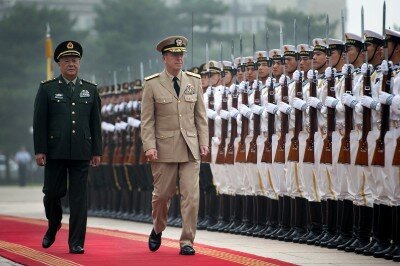 Good news! Bipartisanship has broken out when it comes to the debate over the budget and where cuts might be made. Senate Budget Chairman Kent Conrad (D-North Dakota) has, reports say, devised a plan that would involve $2 trillion in cuts, with the biggest hit—some $900 billion—coming out of the pockets of the Pentagon. Not across the aisle but across the Pacific, Senator Conrad is finding support for his plan from chief of staff of the People’s Liberation Army, Chen Bingde. In a meeting with American chief Admiral Mike Mullen in Beijing yesterday, Chen cheekily remarked in front of the press:
I know the U.S. is still recovering from the financial crisis… Under such circumstances, it is still spending a lot of money on its military and isn’t that placing too much pressure on the taxpayers? If the U.S. could reduce its military spending a bit and spend more on improving the livelihood of the American people… wouldn’t that be a better scenario?
And of course while we’re at it, why not concede Chinese dominance in the Asia-Pacific? And should Senator Conrad have his way with defense cuts, isn’t that the possible outcome in any case?
Cross-posted from the Enterprise Blog.
(DoD/Mass Communication Specialist 1st Class Chad J. McNeeley)
Like Europe in More Ways than One
 Conservative economists and commentators often warn that if the United States does not get its domestic and entitlement spending under control, we could well wind up looking like Europe—a place where economic growth appears to take a back seat to expansive notions of social equity, hyper-regulatory regimes, and pledges of early and expansive retirement benefits. But there is another way in which the United States might begin to look more like Europe. At the end of last week, Chairman of the Joint Chiefs Admiral Mike Mullen remarked that he was concerned that major decisions were being made about the defense budget without sufficient input from the Pentagon on how and where to make cuts. The admiral noted that “the budget train is moving pretty rapidly,” and his worry is that the numbers being tossed around by members of Congress and administration officials—figures running in the hundreds of billions—are a product of narrow budget discussions and largely divorced from how they impact America’s national security strategy.
As such, the current discussion here in DC is not all that dissimilar from what has already taken place in European capitals. In the just released AEI National Security Outlook (“Challenges for European Defense Budgets after the Economic Crisis”), Patrick Keller, foreign and security policy coordinator of the Konrad Adenhauer Foundation in Berlin, Germany, writes that a critical problem in the continuing decline in European defense capabilities has been the failure of Europe’s leaders “to change the tone of the debate” when it comes to thinking about cuts to their defense budgets. According to Keller:
It has been all about saving money when it should be about security. Most Europeans do not feel threatened at all, and they do not grasp that their freedom, their wealth, and their values depend on a liberal world order that is in constant peril. Europe benefits enormously from the stability of the international system, but it does relatively little to uphold it. International order, though, is never a given; it needs to be created and sometimes defended with force.
Words of wisdom for Europe but, as Admiral Mullen suggests, a point more than a few American leaders apparently need reminding of as well.
Cross-posted from the Enterprise Blog.


