
Where are our Carriers? Increasingly, at home.
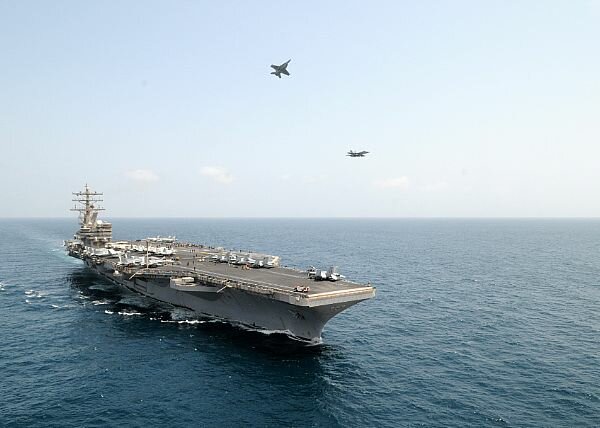
In times of crisis, it is said, presidents immediately want to know where the Navy’s aircraft carriers are. As America’s preeminent symbols of power projection and national presence, the aircraft carriers have been at or near the center of U.S. military strategy for the past 65 years. So potent are they believed to be that Congress has legislatively mandated that a floor of twelve aircraft carriers be maintained at all times. That floor was breached in 2007, with the decommissioning of the USS John F. Kennedy, and the Navy has been operating only eleven carriers for over two years.
Until early 2010, if President Obama wants to know where the carriers are, he can find nearly 40 percent of his force undergoing repairs in Newport News, Virginia. The latest arrival is the USS Theodore Roosevelt, which joins the nearly 50-year old Enterprise, the George H.W. Bush, and the Carl Vinson, all of which are in various stages of maintenance. The Theodore Roosevelt is just beginning its mid-life Refueling and Complex Overhaul program, which will keep it out of service for 41 months, or three and a half years. Meanwhile, the George H.W. Bush, the last of the Nimitz-class carriers, is in the final stages of its pre-operational shakedown, while construction on the next generation Gerald R. Ford is in its early stages.
With four carriers tied up dockside, the U.S. Navy is left with just seven carriers worldwide: the USS Ronald Reagan has just relieved the Dwight D. Eisenhower in the Arabian Sea in support of Operation Enduring Freedom in Afghanistan, and the John C. Stennis is recently back from deployment in the Western Pacific; in the Western Pacific, the Nimitz (commissioned in 1975) has joined the Japan-based George Washington, which is the Navy’s only forward home-ported carrier; Abraham Lincoln and Harry Truman are based in the Atlantic. With transiting, rotations, and repairs, just three carriers are available for the entire Pacific Ocean area. Our operational tempo in Afghanistan is already increasing, but a North Korean or Iranian crisis, let alone other potential conflicts would severely strain the the U.S.’s ability to respond should the national security leadership decide to do so. As the carriers age, there may be future periods when a significant percentage of naval power is unavailable in times of crisis, let alone available simply to maintain regular operations. That may not be an argument for building more of the multi-billion dollar platforms, but the greater danger is that it becomes a de-facto argument to reduce America’s military and maritime presence in future decades. (Photo: U.S. Navy)
Michael Auslin is a resident scholar at the American Enterprise Institute.

China’s Missiles on Parade
Wendell Minnick of Defense News reported last week that China has for the first time publicly displayed the DF-31A, a road-mobile, nuclear ICBM, and the DH-10, a land-attack cruise missile, in a rehearsal for an October 1 parade marking the 60th anniversary of the PRC’s founding. Military and defense officials in China will explain that this is part and parcel of an effort to improve military transparency. This may be true, and foreign observers-who have long complained about the PLA’s opacity-will be happy to get a good look at these weapons next month. The display, however, is not simply an act of openness. As Minnick pointed out, the PLA is also making a statement. With the DF-31A, China is publicly demonstrating that it has a second strike capability (and one capable of reaching Washington, DC); with the DH-10, the PLA reminds us that our forces on Okinawa remain vulnerable.
Neither of these facts is likely to surprise intelligence agencies and China watchers in the U.S. But they are important nonetheless because they (should) remind us of a couple things. First, nuclear weapons are not yet obsolete. President Obama has set a long-term goal of eliminating these weapons completely. This is, perhaps, a noble goal, but in the shorter term, the president must ensure that our nuclear posture is appropriately tailored to ever-changing threats, both from upstart nuclear states like North Korea and from established nuclear powers like China.
Second, this “statement” from the PLA should remind us that the United States and China are engaged in a simmering military competition. The DH-10 is just one of many weapons systems that are at least in part designed to counter U.S. military capabilities. Some systems, like China’s anti-satellite weapons or its forthcoming anti-ship ballistic missile, have been explicitly developed to neutralize American forces. These types of weapons upset the balance of power in the Asia-Pacific, making conflict more likely. One hopes that our leaders are taking the emerging military competition as seriously as China’s are. Should the military balance be allowed to lean in China’s favor, peace in Asia could soon be a thing of the past.
Michael Mazza is a research assistant at the American Enterprise Institute


