
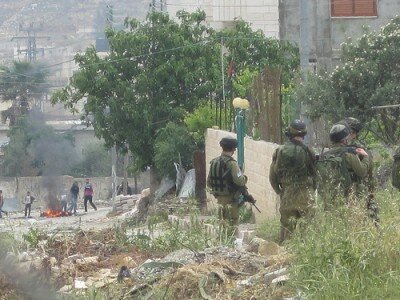
 It is still unclear what exactly happened during the Nakba Day protests on Israel’s northern border last Sunday, but thanks to Haaretz’s Amos Harel , things are a little less murky on the Israeli side.
We do know that hundreds of Palestinian protesters swarmed the Syrian and Lebanese borders with Israel in an attempt to infiltrate. Many managed to reach the main square of the Druze village Majdal Shams on the Golan Heights, and one Palestinian even made his way to Jaffa. Israeli soldiers,-outnumbered 100 to 1 in some places and under a barrage of flying rocks- opened fire at Palestinians crossing the fence. Near Majdal Shams, four protesters were killed and more than 100 injured, while around 10 were killed on the Lebanese border. Israel claims that the Lebanese Army opened fire indiscriminately, causing most of the casualties. Israel has been reluctant to release footage of the incident out of concern that the humiliation of the Lebanese Army will keep them from acting to stop future infiltrations. Internal IDF reviews of the incident are obviously classified, but some information is starting to emerge.
Per Haaretz‘s Harel , we are able to begin gathering a picture of what happened that day on the Israeli side. His article details the initial review within the Northern Command on the incidents.
Here’s how the events played out for the IDF-
On the Syrian front, Division 36 received intelligence that mass protests would occur at Kuneitra, 25 km south of Majdal Shams. They deployed two battalions in the area.
10:30 am- In the Majdal Shams area, IDF spotters notice a few small buses of protesters and Syrian soldiers gathering across the border.
11:30 am- The IDF observes 90 buses rolling toward the border near Majdal Shams from Damascus. Col. Eshkol Shukrun, Golani Brigade Commander, sends only a reserve CO with seven soldiers to the area.
12:30 pm- The reservists at Majdal Shams observe thousands of protesters gathering on the “Hill of Shouts”, 400 yards from the border. Col. Shukrun calls in soldiers from a tank battalion as reinforcements.
12:35 pm- Tens of protesters begin running toward the border fence, scuffling with the Syrian soldiers. They manage to steal two rifles and fire several shots toward Israel. They tear at the fence, trying to get into Israel. 1500 protesters swarm down the hill behind them.
12:55 pm- The eight IDF soldiers face 1000+ angry protesters on the fence. In accordance with IDF rules of engagement, the soldiers begin selective fire at the feet of protesters crossing the fence. Within three minutes, 150 Palestinians cross the fence.
12:58 pm – Col. Shukrun arrives on the scene. Shukrun and the reserve CO take a number of decisions in the field:
· To separate the protesters on the Syrian side from those who had infiltrated.
· To fire only at individuals endangering the lives of soldiers.
· Despite the hundreds of Druze from Majdal Shams throwing stones at the soldiers, they decide not to place a closure on the town. Instead, they send backup police and soldiers to the Druze town to contain the protesters who had infiltrated.
The IDF enters into discussions with the local Druze leaders, and convinces them to return the protesters to Syria. 137 uninjured protesters are brought back to Syria.
5:00 pm- Col. Shukrun reports that the incident has ended.
The IDF incident review focused on the failure to call in the tank battalion to Majdal Shams at 11:30 am, when the protesters started massing. The hour-long wait before ordering in the battalion proved extremely costly. Also, backup forces were stationed too far from the border, and took a half hour to arrive. But overall, the IDF was not too distraught from the incident. Ultimately, the speedy decisions taken by commanders in the field prevented massive civilian deaths.
On the Lebanese border, the situation was quite different. Israel had intelligence about massive protests on the border, and concentrated forces at three points on the fence. Israel also warned UNIFIL and the Lebanese army that it would use force to stop any infiltration. This seems to have worked somewhat, as the Lebanese Armed Forces (LAF) did stop protesters in some places, but Palestinians managed to break through the fence near Moshav Avivim.
Snipers and sharpshooters from the Golani Brigade opened fire at the protesters’ legs below the knee. The IDF reports that the Lebanese soldiers opened fire indiscriminately at the protesters. In addition, some protesters were injured when they stepped on the anti-personnel mines that lie on the Israel-Lebanon border. The incident ended with 10 dead protesters and 130 injured.
Harel reports that the IDF has noticed the difference in the way the Lebanese army acted in this incident as compared to the August 2010 border flare-up. In that incident, LAF soldiers killed Lt. Col. Dov Harari as he commanded reserve soldiers cutting trees on the border, resulting in heavy IDF retaliation. This time, the LAF was completely uninterested in conflict with Israel, and even used heavy fire to keep protesters off the border.
It is important to note that the violence did not lead to any additional protests, and that quiet has returned to the border. However, the IDF is concerned about protests returning on upcoming Fridays, meant to draw attention away from the regular Friday protests against Assad, and about the date of June 6th, the anniversary of the Six Day War battles that resulted in Israeli control over the Golan Heights.
So how much damage did this incident do to Israel? On balance, not much. The usual anti-Israel folks used this as another club with which to hit Israel, fine. But they are going to criticize Israel for any loss of Arab life, so Israel can only fret about that so much.
Could Israel have handled this better? Of course, but Andrew Exum and other intelligent critics of the IDF response should remember that these protests could easily have ended in major loss of life, but the IDF was able to prevent that outcome. Israel has to manage a 150 mile border with Syria and Lebanon, and cannot guard every inch with soldiers on the fence. It will take a combination of intelligence, surveillance, deterrence and mobile defense to keep the border secure, but determined infiltrators will inevitably make it across from time to time.
It would be helpful to view the Israeli footage of the events, especially the LAF fire on the protesters. It would help the Israelis in their PR efforts, but they are thinking about the tangible problems that releasing the footage would cause. Showing the LAF firing on Palestinians would bring significant pressure on them to not serve Israel’s interests, and would make the LAF much less likely to attempt to control protesters on the border next time.
The quicker the IDF is able to learn from its mistakes on Sunday, the better prepared it will be to drive off future protests without loss of life, and the harder it will be for Assad to divert Arab and world attention from his crackdowns on Syrian civilians.



