
China Thumbs its Nose
 Air China must be offering specials this month on flights to Beijing from rogue states. Over the past 10 days, Pakistani Prime Minister Yusuf Raza Gilani, North Korean leader Kim Jong-Il (his third time in the past year), and Burmese President Thein Sein have all visited China. (Is it fair to include Pakistan in a list of rogue states? It may be – my colleague Apoorva Shah has recently explained why Pakistan and North Korea have more in common than you might think). All three are countries with challenging, if not antagonistic, relationships with the United States. All are countries which Washington is trying to pressure, isolate, or otherwise punish. And all engage in some activities (in the case of Pyongyang, lots of activities), which are severely detrimental to U.S. national security interests.
These visits have been fruitful for each of the foreign leaders. Pakistan secured the emergency delivery of 50 JF-17 fighter jets; the original two-year timeline has been sped up to six months (see AEI Resident Fellow Dan Blumenthal’s great WSJ article on this).
Though Kim Jong-il reportedly failed to secure the Chinese investments he was hoping for, he did receive a warm welcome. Indeed, the official Chinese news agency reported that “Chinese President Hu Jintao said”—and with a straight face, no less!—“China was glad to see the Democratic People’s Republic of Korea (DPRK) gives top priority to improving people’s lives.” According to the BBC, “Chinese state television showed Mr. Kim being embraced and kissed by the Chinese president…The warmth of coverage of his visit, and the flattery of official comments by China, gave Mr. Kim much-needed political support, analysts said.”
Lastly, during Thein Sein’s visit, China and Burma “upgraded their relationship to strategic partnership and inked economic agreements.”
While the specific reasons behind China’s relationship with each of these three states differ, Beijing nurtures all three in an effort both to complicate the international environment for the United States and to pursue a predominance of influence (and eventually power) in the Asia-Pacific.
The timing and quick succession of these three visits is also indicative of growing Chinese bravado. China is, for all intents and purposes, thumbing its nose at the United States, and it is doing so confident that Washington will not respond. Its confidence is apparently well-placed. While Beijing does not let Washington cast a passing glance at Taiwan without throwing a fit, Washington refuses to return the favor when Beijing praises murderers and supplies “emergency” jets to the country that safely harbored Osama Bin Laden for the past half decade. This is, to put it lightly, unfortunate. Washington’s silence only assures that China (and others) will continue to impinge upon American national security interests whenever and wherever they can.
Cross-posted from the Enterprise blog.
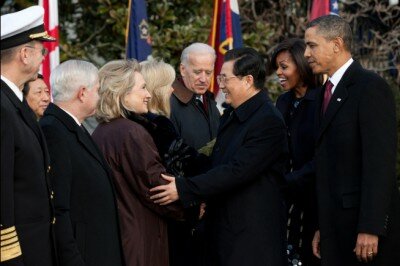
(White House/Pete Souza)



